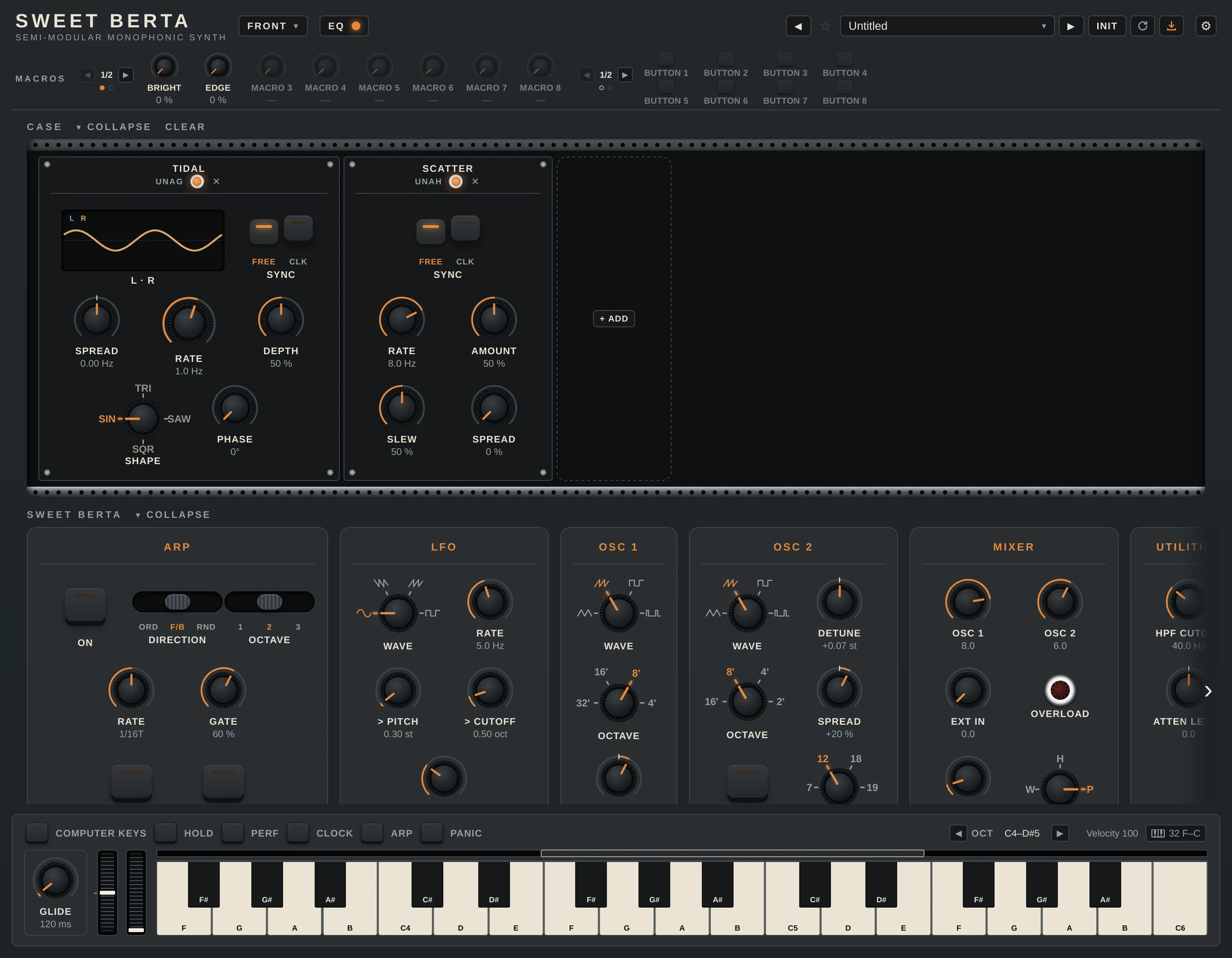
 Hybrid
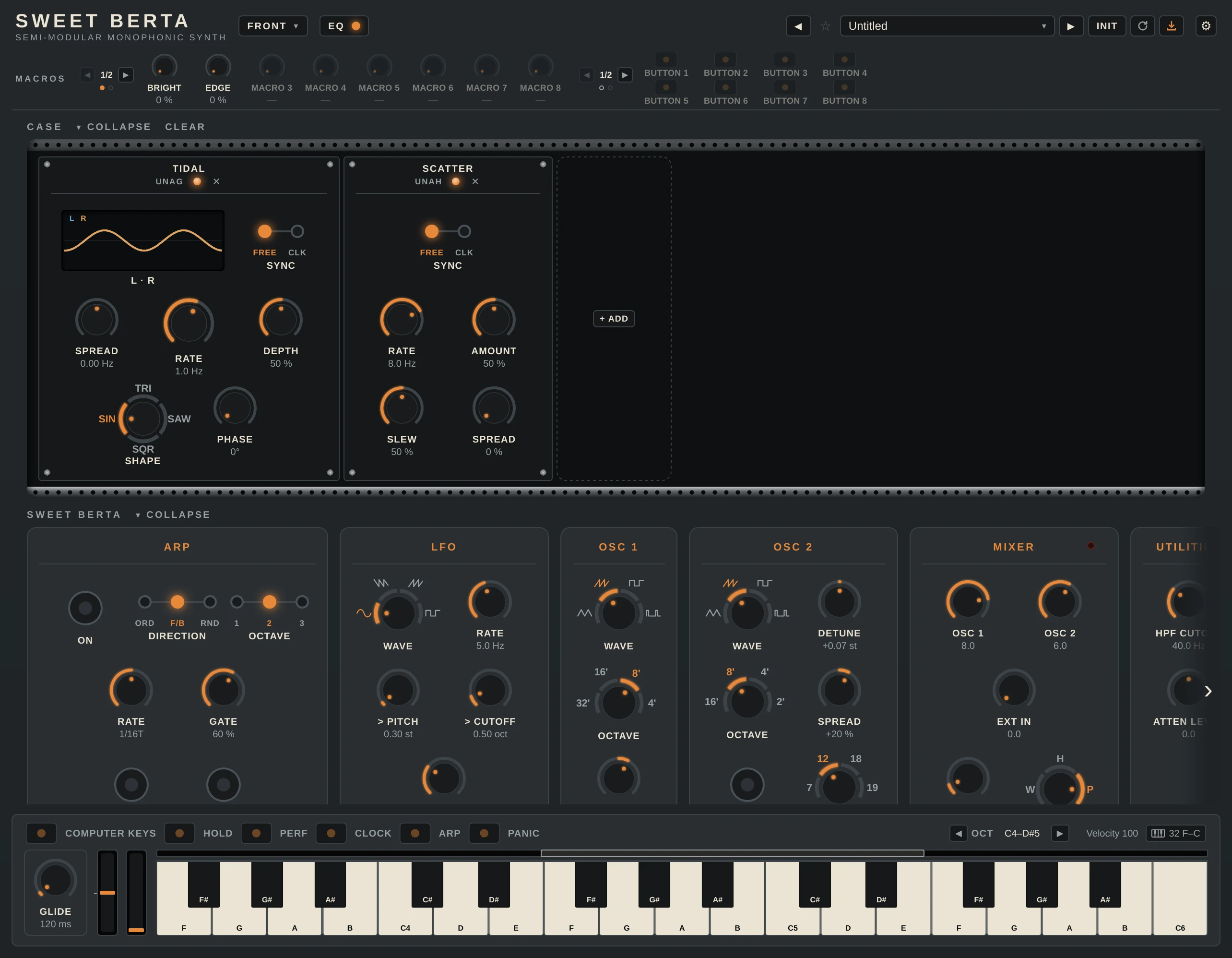 Modern
Manual tip: MIXER OUT -> HPF IN, HPF OUT -> LADDER IN. The HPF takes everything below 300 Hz out before the resonant ladder, so the two together make a nasal band-pass lead. Turn HPF CUTOFF to move the bottom edge and CUTOFF the top. Macros: Thin, Bright, Bite. Macro 8, Master, is the output level.
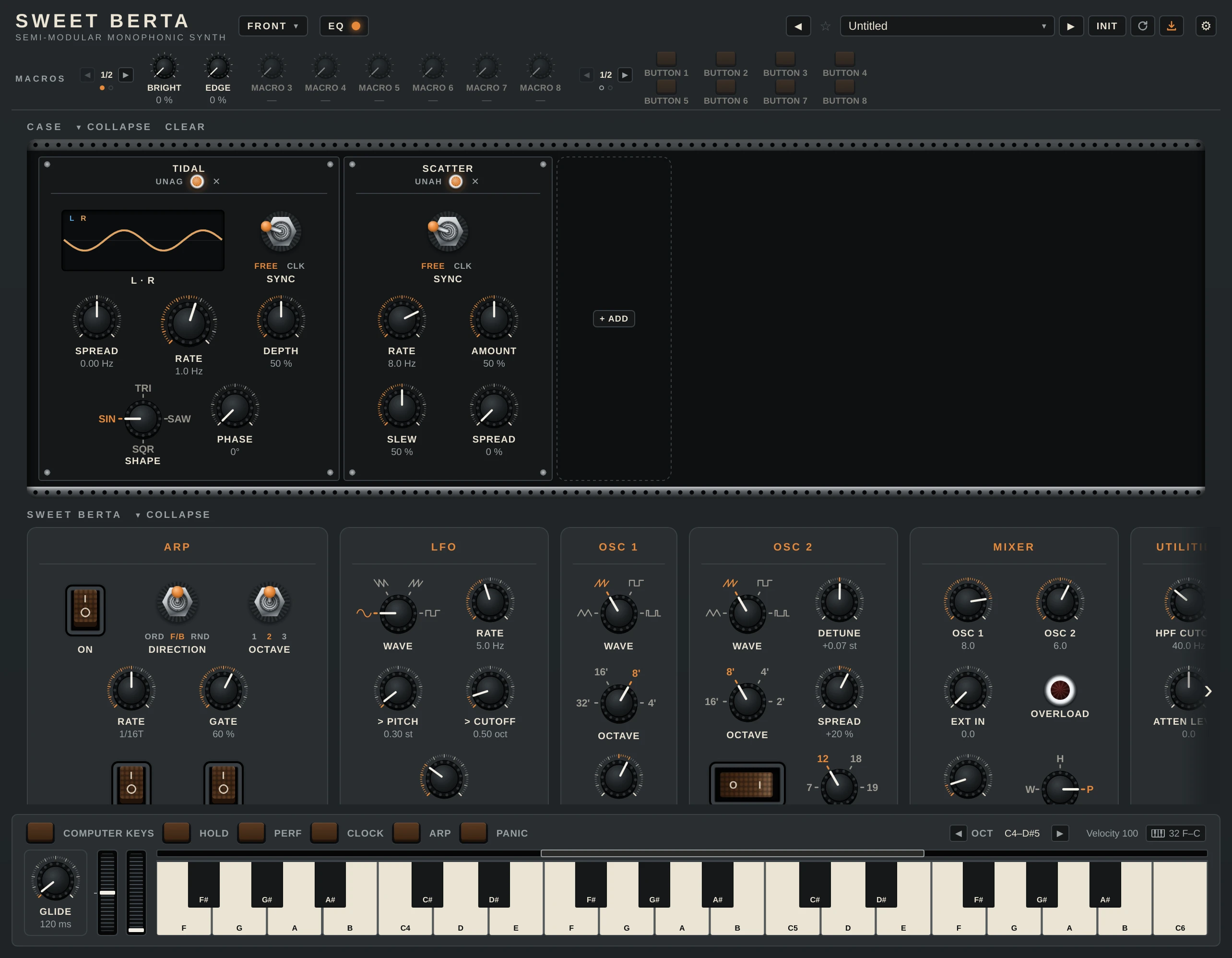
Semi-modular monophonic synth
Sweet Berta
One voice, patched your way. Two oscillators, a ladder filter, a sequencer and an arpeggiator, a patch bay of cables, and a spring reverb.
The launch
Free to claimOpens: October 21, 2026 at 12:00 AM UTC. No closing date yet.
Sweet Berta installs with the Ozner Audio app and a free account. Get the app
AUVST3Standalone
The gallery
Every side of the panel, as the plugin draws it1–24 of 24
Manual tip: FILTER OUT -> HPF IN, HPF OUT -> VCA IN. A fat, resonant ladder patch with an octave-down osc 1, whose sub-bass the HPF shaves off after the ladder so it sits above a bass line. Raise HPF CUTOFF to thin it further. Macros: Thin, Bright, Bite. Macro 8, Master, is the output level.
Manual tip: +ENV OUT -> CUTOFF IN. ENV AMT at full cannot open the ladder all the way from the bottom; the cable adds five more octaves, so the envelope sweeps the cutoff from 30 Hz past the top of the audio band on every note. A full-range zap. Macros: Decay, Bite, Floor. Macro 8, Master, is the output level.
Manual tip: S/H OUT -> CUTOFF IN. S/H OUT samples noise at the start of every LFO cycle, so the cutoff jumps to a new random place eight times a second: the classic burbling random filter. LFO RATE sets the step rate. Macros: Rate, Bite, Cutoff. Macro 8, Master, is the output level.
Manual tip: an audio-rate LFO into PITCH IN. The sine LFO runs at 523 Hz, and KB PITCH into RATE IN makes it track the keys 1:1, so it stays an octave above the note everywhere and the FM stays harmonic: a bright, glassy, electric-piano-like pluck from one triangle. Macros: Ratio, Bright, Decay. Macro 8, Master, is the output level.
Manual tip: osc 1 -> osc 2 LIN FM IN. Osc 2's triangle is the carrier, at the played pitch; osc 1 is the modulator, unheard, at 4' and pushed a further 5.5 semitones up by the ATTENUATOR (an offset with nothing in its input) into osc 1 PITCH IN. The 2.75:1 ratio is inharmonic: a struck bell, decaying over three seconds. Macros: Clang, Ring, Vibrato. Macro 8, Master, is the output level.
Manual tip: a hard-sync sweep on the mod wheel. Osc 2 is synced to osc 1 and alone is heard; the wheel raises it up to an octave, sweeping the sync timbre. How: the LFO's pitch normal reaches both oscillators through the wheel, a zero-valued ATTENUATOR cable into osc 1 PITCH IN breaks it for osc 1 only, and +ENV OUT into LFO SYNC IN restarts the slow square on every note, so it holds at its top for about 7 s: a steady offset the wheel scales. Macros: Sweep, Bright, Release. Macro 8, Master, is the output level.
Manual tip: ATTENUATOR OUT -> RATE IN. With nothing in its input the attenuator is a steady offset, and in RATE IN it takes the LFO past the slowest the RATE knob reaches: one cycle here lasts about a minute, sweeping the cutoff two octaves either way under long, detuned saws. Hold chords and let it drift; turn the ATTENUATOR towards 0 to speed it back up. Macros: Rate, Cutoff, Space. Macro 8, Master, is the output level.
Manual tip: the LFO played as an oscillator. RATE IN follows a volt per octave, so KB OUT -> RATE IN makes the LFO track the keys, and its WAVE OUT patched into the mixer's EXT IN makes it a third oscillator: a square an octave under two 16' saws, a thick three-oscillator bass. LFO RATE tunes it (65.4 Hz is that octave at middle C). Macros: Sub, Cutoff, Drive. Macro 8, Master, is the output level.
Manual tip: KB OUT -> RATE IN, at half strength. The LFO follows the keys, so the vibrato quickens as you play higher, by half an octave for every octave, as a singer's does on a high note. Bring the mod wheel up for the vibrato and play a slow line across two octaves. Macros: Vibrato, Bright, Echo. Macro 8, Master, is the output level.
Manual tip: GATE OUT -> LFO SYNC IN, with RATE at its slowest. Each key restarts the LFO, which steps S/H OUT, so every note you play lands on a new random cutoff, and the resonance rings at a new place: the same riff never sounds the same twice. Play short repeated notes. Macros: Cutoff, Decay, Echo. Macro 8, Master, is the output level.
Manual tip: OSC 2 -> HPF IN, HPF OUT -> the mixer's OSC 2 IN. Osc 2 is shaped on its own before the mixer: the HPF takes its body away, leaving a buzzy narrow-pulse edge two octaves up, riding on osc 1's full 16' saw, so the brass bites without getting thin. HPF CUTOFF sets how much edge; the mod wheel adds vibrato. Macros: Edge, Bright, Space. Macro 8, Master, is the output level.
Manual tip: each oscillator through its own filter. Osc 2 runs through the HPF straight to VCA IN, and FILTER OUT joins it there (two cables into one input add, as a mult would), while osc 2's mixer level is down, so the ladder hears osc 1 alone. With VCA MODE on KB RLS, osc 1 plucks and closes while osc 2's thin, high shimmer holds for as long as the key does. Macros: Shimmer, Pluck, Space. Macro 8, Master, is the output level.
Manual tip: LFO WAVE OUT -> VCA AMT IN, for tremolo. A cable into VCA AMT adds to the envelope's level, so on its own the LFO would hold the VCA open after you let go; ATTENUATOR OUT into the same jack offsets it down by the LFO's depth, so the two only ever dip the level and the note still ends. Soft triangle keys throbbing at 5 Hz. Macros: Rate, Bright, Space. Macro 8, Master, is the output level.
Manual tip: LFO WAVE OUT -> VCA AMT IN at audio rate, for amplitude modulation. KB OUT -> RATE IN holds the LFO at 1.41 times the note wherever you play, and the ATTENUATOR's offset in VCA AMT keeps the note's end clean, as in the tremolo patch. The sidebands it adds are out of tune with the note: a glassy, metallic chime that grows rougher as it rings away. Macros: Ratio, Decay, Space. Macro 8, Master, is the output level.
Manual tip: a triangle with one richer wave beside it. Osc 1's triangle carries the note almost pure, and a quiet square on osc 2 an octave up adds the second harmonic, which the key-tracked ladder keeps while it trims the square's own buzz: one partial stands out, with none of a saw's crowd. A breath of pink noise and a soft attack make it a flute; the mod wheel adds vibrato. Macros: Breath, Harmonic, Space. Macro 8, Master, is the output level.
Manual tip: modulating osc 2's frequency brings hard sync alive. S/H OUT -> OSC 2 PITCH IN throws the synced osc 2 to a new pitch eight times a second, and ATTENUATOR OUT into the same jack lifts it so it never drops under osc 1, where sync goes quiet. The note stays put while each step is a new vowel-like colour: a chattering, talking lead. Macros: Rate, Bright, Echo. Macro 8, Master, is the output level.
Manual tip: pulse-width modulation as a chorus. Two squares: LFO WAVE OUT -> OSC 1 PWM IN sweeps osc 1's width slowly, and the mod wheel brings in the LFO > PULSE WIDTH normal, which moves both. As the wheel rises the pair thickens and shimmers like an ensemble, with no chorus pedal at all. Hold chords. Macros: Rate, Bright, Space. Macro 8, Master, is the output level.
Manual tip: KB VEL OUT -> CUTOFF IN. Velocity has no route of its own; patched into CUTOFF IN it lifts the whole filter, by up to two octaves, with how hard you strike, and holds it there for the length of the note, sustain and all. Soft notes are round and mellow, hard ones bark. Play with dynamics. Macros: Cutoff, Decay, Space. Macro 8, Master, is the output level.
Manual tip: KB OUT -> CUTOFF IN, on top of KBD TRACK at 1:1. The cutoff now climbs two octaves for every octave played: low notes come out round and muffled, high ones open right up and glassy. One patch, a whole range of colours: play a bass line with the left hand and a bright pluck with the right. Macros: Cutoff, Decay, Echo. Macro 8, Master, is the output level.
Manual tip: VCA MODE on KB RLS, with an exaggerated filter envelope. The VCA opens fully the moment a key goes down and holds until you let go, so the envelope only shapes the filter: a hard, resonant snap through five and a half octaves that falls to a closed, dark rumble for as long as you hold. Play staccato for snaps, hold for growl. Macros: Snap, Cutoff, Decay. Macro 8, Master, is the output level.
Manual tip: the mixer is DC-coupled, so it can blend control signals. The oscillators go straight to FILTER IN, freeing the mixer: its OSC 1 IN takes the LFO's smooth sine, OSC 2 IN takes S/H's random steps, the two level knobs set the blend, and MIX OUT -> CUTOFF IN plays the result on the filter: a wobble bass with a random stagger in it. Hold long notes. Macros: Smooth, Steps, Rate. Macro 8, Master, is the output level.
Manual tip: GATE OUT -> LFO SYNC IN steps S/H once a key, here into osc 2's pitch: every note detunes osc 2 by its own small, random amount, so a line beats and wavers like a worn instrument, never twice the same. Play chords and slow melodies. Macros: Bright, Decay, Space. Macro 8, Master, is the output level.
Manual tip: each oscillator through its own filter, for a bass that carries on small speakers. Osc 1, a 16' triangle, goes through the ladder and stays round and low; osc 2, a saw an octave up with its mixer level down, goes through the HPF straight to VCA IN beside FILTER OUT, so only its upper harmonics come through. The line reads on a phone while the low end stays clean. Macros: Edge, Cutoff, Decay. Macro 8, Master, is the output level.