Semi-modular monophonic synth
Sweet Berta
One voice, patched your way. Two oscillators, a ladder filter, a sequencer and an arpeggiator, a patch bay of cables, and a spring reverb.
The launch
Free to claimOpens: October 21, 2026 at 12:00 AM UTC. No closing date yet.
Sweet Berta installs with the Ozner Audio app and a free account. Get the app
The gallery
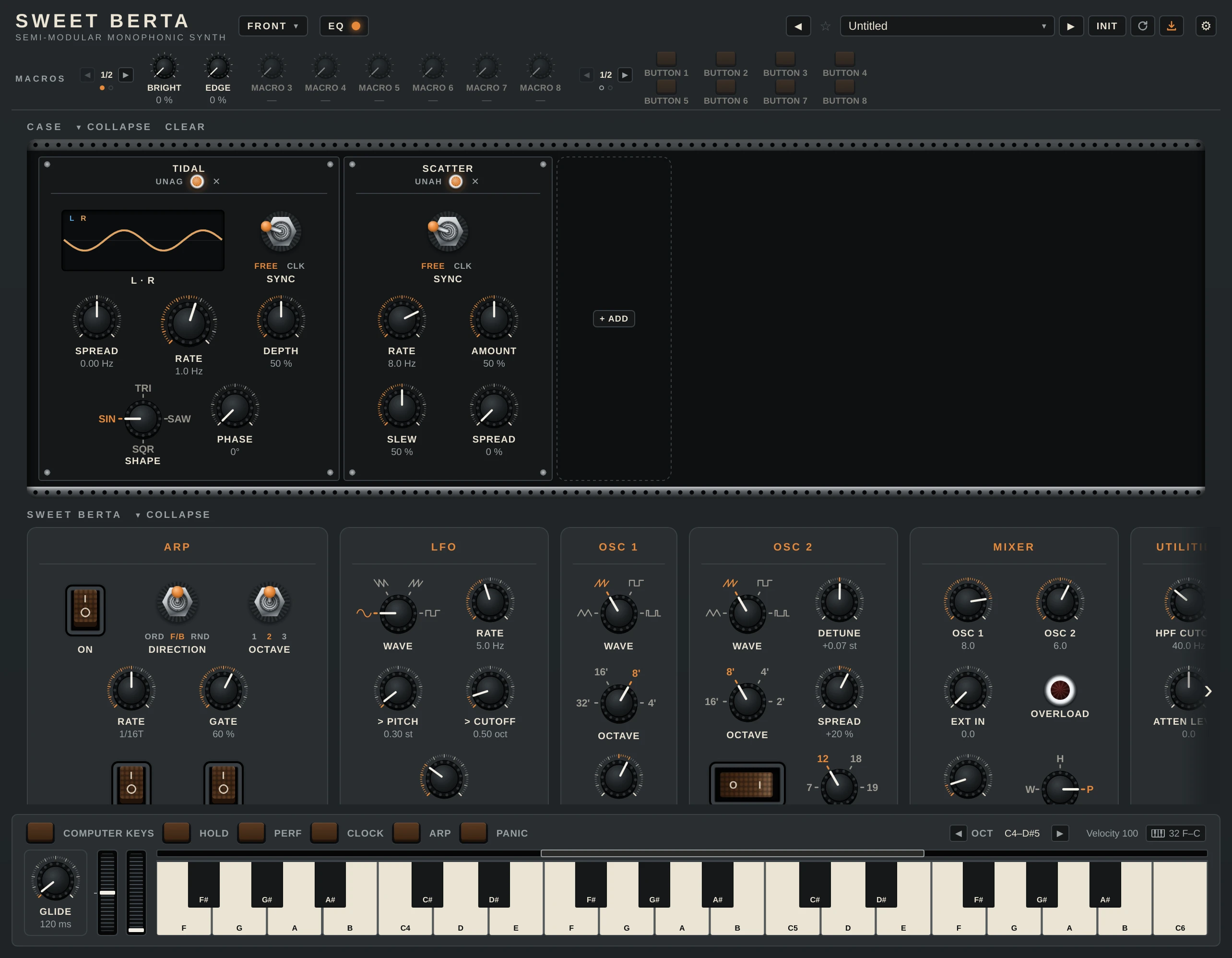
Every side of the panel, as the plugin draws it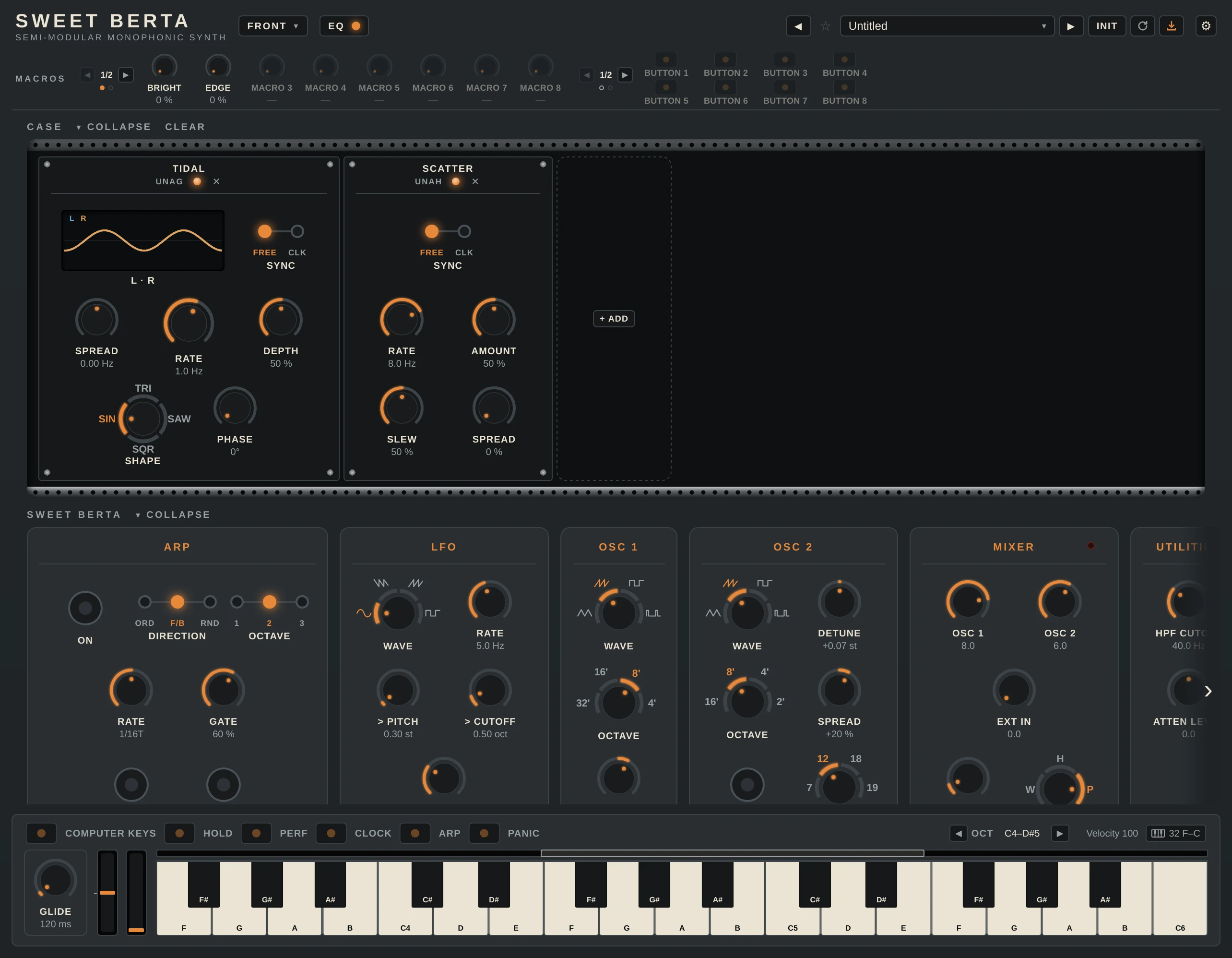
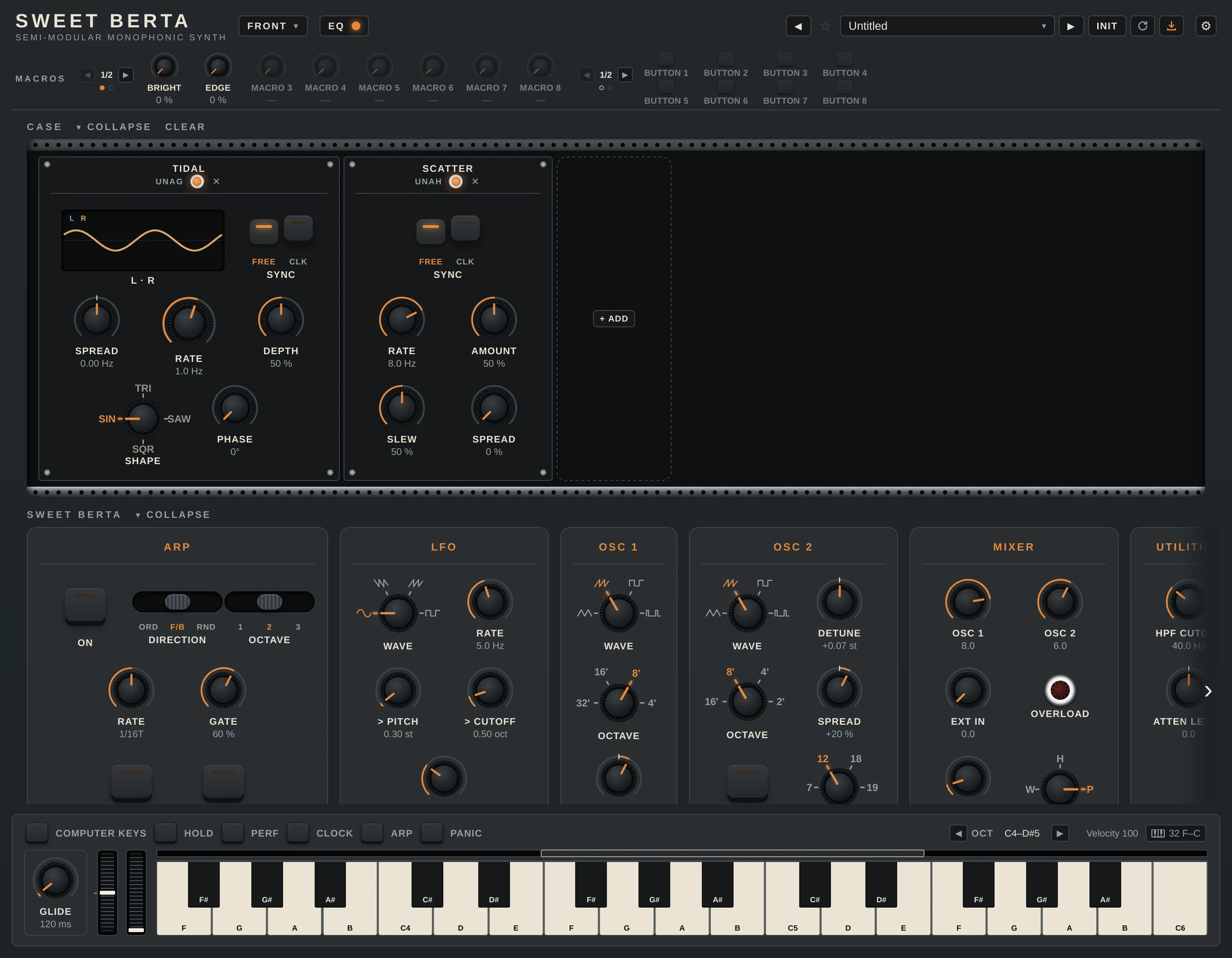 Hybrid
Left to right, the order the panel draws them: every control, as its hover label says it.
Arp
Plays the held keys as an arpeggio; switches the sequencer off.
The order the notes were played, that order then back (Fwd/Bkwd), or at random.
Plays the pattern over 1, 2 or 3 octaves.
Each step's length, as a division of the clock's tempo.
How much of each step its note lasts.
Fwd/Bkwd plays the end notes twice at each turn (A B C C B A), or once (A B C B).
Follow the Clock's Swing.
LFO
The LFO's shape: sine, falling sawtooth, rising ramp or square.
How fast the LFO cycles, up to audio rate.
How far the LFO moves both oscillators' pitch, at full mod wheel.
How far the LFO moves the cutoff, at full mod wheel.
How far the LFO moves the pulse width, at full mod wheel.
OSC 1
Osc 1's waveform: triangle, saw, square or narrow pulse.
Osc 1's range: 8' is the played note, each halving an octave up.
Spreads osc 1 apart in stereo.
OSC 2
Osc 2's waveform: triangle, saw, square or narrow pulse.
Osc 2's tuning against osc 1, up to the Range's semitones either way (about 36 with Sync on, whatever the Range).
Osc 2's range, which sits an octave above osc 1's.
Spreads osc 2 apart in stereo.
Hard-syncs osc 2 to osc 1: each cycle of osc 1 restarts osc 2.
How far Detune turns, in semitones either way: 7 a fifth, 12 an octave, 18 the widest the classic hardware allows, and 19 (ours) an octave and a fifth. A global setting, brought onto the panel and saved with each preset. Moving it moves no pitch.
Mixer
Osc 1's level into the mixer; the stage bends from the first level, by 1 dB at about 7.7 with osc 1 alone.
Osc 2's level into the mixer.
The external input's level into the mixer, or that of whatever is patched into the Ext In jack.
The noise's level into the mixer.
The noise's colour: white, hybrid, pink or brown.
Utilities
The high-pass filter's cutoff: patch HPF In and HPF Out to hear it.
Atten Out's level with nothing in Atten In; with a cable in, how much of it passes (below 0 inverts).
Filter
The ladder filter's cutoff frequency.
Emphasis at the cutoff; near the top the filter sings on its own.
How far the envelope moves the cutoff, up or down.
Spreads the two sides' cutoffs apart in stereo.
How many of the ladder's stages the sound leaves after (dB/oct). 24 is the classic, deep and round; 18 a touch more open; 12 brighter and buzzier, its resonance sharper; 6 very gentle.
How far the cutoff follows the keys: 1:1 tracks them exactly.
Envelope
How long the envelope takes to rise.
How long the envelope takes to fall to the sustain level.
How long the envelope takes to fade once the key is up.
The level the envelope holds while a key is down.
Output
The voice's level, into the effects.
The plugin's output level, after the effects. Macro 8 turns it.
What opens the VCA: the envelope, full level until the key's release (KB Rls), or always (Drone).
On the keyboard bar
Performance
Which held key sounds when more than one is down.
On: only overlapping notes glide, and a detached note jumps.
How long the pitch takes to slide to a new note.
A slow random wander of each oscillator's pitch.
Shifts everything the synth plays, in semitones.
How far the pitch wheel bends, in semitones either way.
Clock
Host follows the DAW's tempo and play/stop; Internal always runs at Rate.
The tempo at Internal sync, and at Host for a DAW that reports none; Tap sets it.
Delays every second step: 50% is straight; higher lengthens the first of each pair.
Press in time to set the clock's Rate.